
Why do we Kill? (Part Three)
Performing Dostoevsky's Crime and Punishment: Russian Film by Lev Kulidzhanov

When I translate a scholarly scientific paper from Russian my objective, as a geologist, is to communicate as accurately as possible the information in English. My task is strictly determined by this simple rule.
Something different occurs when I work with a Russian story, poem or a novel.
In Russian this type of literature is called художественная литература (khudozhestvennaya literatura). Strangely I can’t translate this term adequately into English. The word ‘fiction’ seems wanting because it only represents a fragment of what the Russian term represents. Creative literature is also ineffective because scientific papers are also creative. The closest terms that I can find are artistic literature (a literal translation), and belles-letters, roughly meaning ‘beautiful words’. Maybe belletristic will be a better equivalent of the Russian term. In Russia of the times of Pushkin, Gogol, Chekhov, and Bunin, it was frequently applied to novels, and novellas.
Another term that comes to mind, and is closer to the intended meaning of художественная литература seems to be imaginative literature. I like this term although it sounds clumsy and mouthful.
In works of imaginative literature the role of language is not merely to communicate information but to achieve something more substantial. Language doesn’t function just as a tool (such as a hammer) or an instrument (such as a cello) but is the work itself. The closest metaphor that helps to convey what I mean, are the brush-strokes in a painting. Unlike the canvas, on which the painting is created, the brush-strokes constitute the painting.
In books of imaginative literature such as Crime and Punishment we hear voices speaking, listening, and responding. A word or a phrase spoken by someone becomes an utterance. This is what I have learnt from Mikhail Bakhtin.
An utterance is framed by speaker’s intention. As a result, in an utterance thoughts and emotions are inseparably linked. In imaginative literature this association reaches a new level. Therefore as a translator of a poem or a story, my objective is to translate utterances and not just words and phrases. To convey information is important but it is secondary to the fabric of thoughts and emotions.
Human emotions are generally similar across cultures but how they are expressed are specific to a language and culture. This difference becomes more significant when oral words are communicated in the form of writing. Written languages often fall short when tasked to deal with the spoken-ness of words.
For example in Russian there are many частицы (particles) such as, даже (dazhe) ведь (ved’), which are used to add emphasis to the expression. There are also союзы (conjunctions) like так (tak) and то (to). Their meaning and role alter depending on the context.
In the exchange between Raskolnikov and Sonya that I discussed in Part One of the essay, and will refer to again now, both particles and conjunctions are used. Their presence and intention are largely overlooked in the English translations I have come across.
In Russian the exchange between Raskolnikov and Sonya reads:
Raskolnikov: Я ведь только вошь убил, Соня, бесполезную, гадкую, зловредную.
Sonya: Это человек-то вошь!
Raskolnikov: Да ведь и я знаю, что не вошь,
I have highlighted particles and conjunctions in the text. Michael Katz, whose English translation of Crime and Punishment I like, calls these little words ‘murdering’ or troublesome for a translator.
The most common English translation that I have found of the above text is:
Raskolnikov: I merely killed a louse, Sonya, a useless, vile, pernicious louse.
Sonya: That louse was a human being!
Raskolnikov: Even I know she wasn’t a louse…
All English translations, like the one above, convey the information contained in the Russian text perfectly well. Therefore there isn’t much wrong with this translation. It is correct and accurate.
Please note that Dostoevsky adds an exclamation mark after Sonya’s reply.
What does this mark represent? Linguists suggest that it was invented and began to be used commonly to avoid people reading the text in a flat tone. The mark was introduced to express speaker’s surprise, excitement, or agitated state.
I think this is what Dostoevsky wants us to notice: Sonya is confused, angry, aghast. Reading ‘that louse was a human being!’ in a flat, even tone won’t create the same impact. You have to intonate the utterance with emotions. The written utterance of mere six words carries a load of several emotions.
I wrote to Michael Katz, asking him if he could tweak his translation just a little to express its spoken-ness. He kindly sent me an edited version, and together we created the following:
Raskolnikov: Why, I merely killed a louse, a useless, vile, pernicious louse
Sonya: Wasn’t she, the louse, … a human?!
Raskolnikov: Yes, even I know she wasn’t a louse.
In addition to the exclamation mark appended by Dostoevsky I attached an extra question mark. I soon realised that a set of emojis such as, 😡😳🤢, after Sonya’s reply would be a good guide for the readers and actors to notice the emotional weight of the utterance.
In order to capture the spoken-ness of a written utterance, it has to be read and spoken aloud. In audio books the voice of an artist is versatile to convey the orality of written word as demonstrated by this audio recording (please click on the link and go to Part 5, Chapter 4b; the section about the ‘louse’ starts at around 5 minutes into the chapter).1
As we listen to the voice of the artist our imagination recreates her enacting the utterance, as if, we had tuned to a radio play. For a moment we want to see her as well, which can either happen in a video clip, or more fully only on the stage of a theatre or on the screen of a cinema (or of any other device). This is because real humans, seen and heard, can embody the whole substance of an utterance.
Actors possess skills to accomplish the same task with added facility and conviction. Through them an utterance is able to capture our attention and we are ready to engage and be enthralled.
I wonder if the actors can be helped a little by a script with legible prompts and directions. Having said that, I readily concede that most directors and actors either possess an innate sense to decode the emotions or are trained and conditioned to do that.
Maybe I am demanding too much from a translator or a playwright. I should just relax and have faith in the expertise and talent of theatre practitioners and film makers.
The novel Crime and Punishment has inspired hundreds of adaptations into plays and films in many languages. Some of them are lauded and remembered as classics.
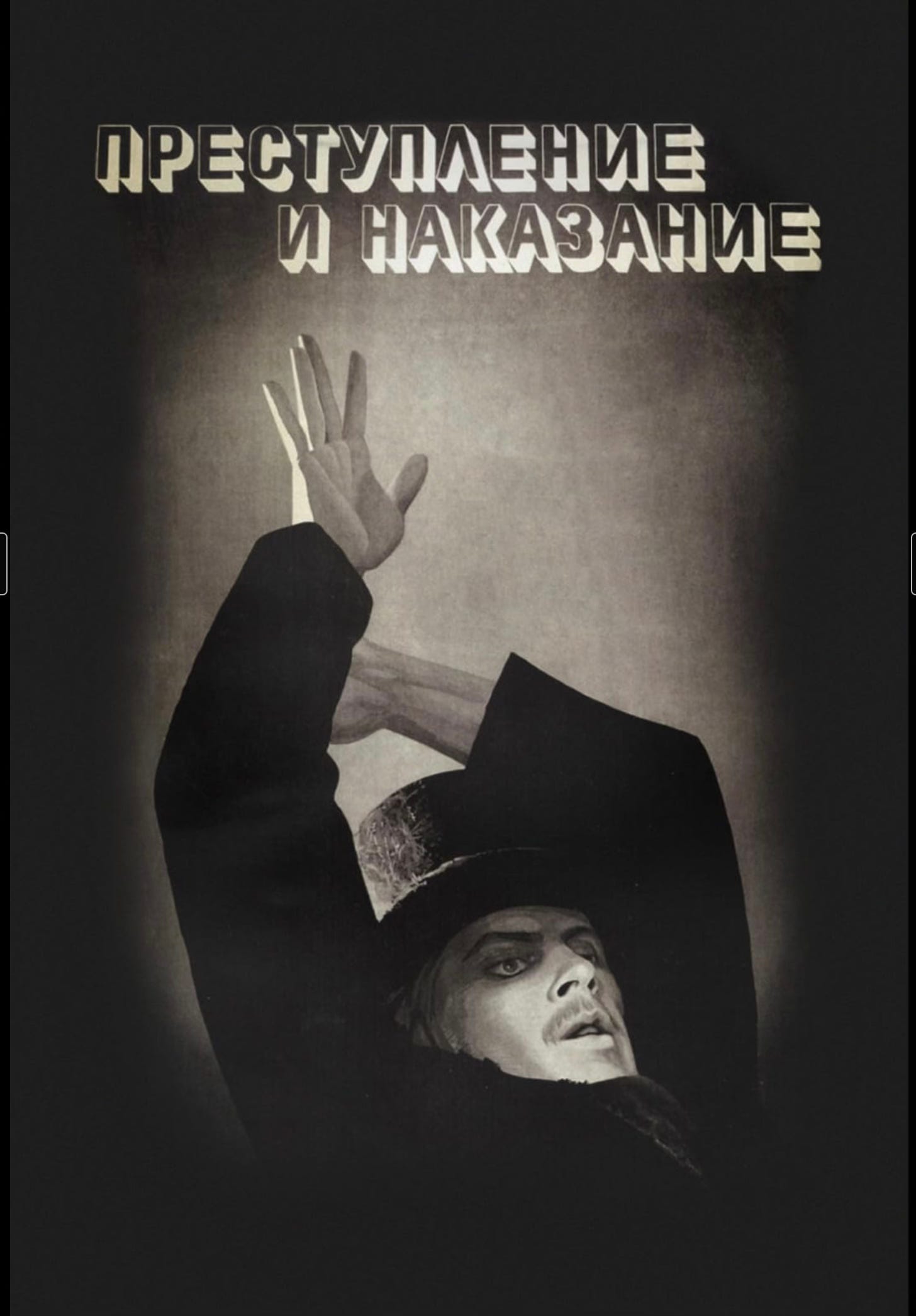
In 1972 I watched in Moscow one of such classics: a Russian film adaptation directed by Lev Kulidzhanov.
The film runs for more than three hours and has two parts.
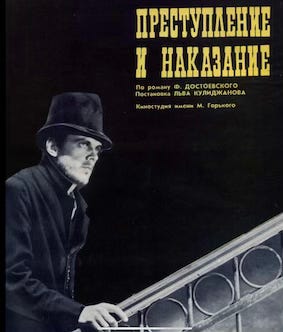
The black and white colour of the film looks appropriate to represent the poor and depressing setting of the nineteenth-century St. Petersburg.
The film cleverly uses the voice of Grigory Taratorkin, the actor playing Raskolnikov. One can hear it in the background as he walks in the streets, or tosses and turns in his sleep. The voice-over successfully expresses his internal monologue. Often it turns into a dialogue in which he sometimes talks to his own anguished self or argues with his mother, sister, Sonya or even Porfiry Petrovich.
Cinematographic camera has in its armoury different types of shots varying between close-ups, and shots of different ranges. Through them the cinema can narrate and show the story from different angles. One of the most powerful of these is the point-of-view shot when the camera shifts, as if, from behind one character to another, giving us a chance to watch what they are seeing, hearing, and listening. Kulidzhanov deploys this technique skilfully during the conversations between Sonya and Raskolnikov and between Raskolnikov and Porfiry Petrovich.
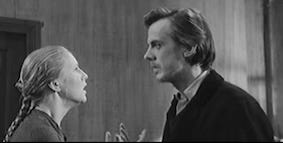
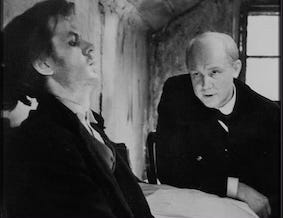
I have watched the film many times since my first encounter in 1972. Each time It leaves me stunned and breathless, especially the scenes involving Sonya.
Tatiyana Bedova who plays Sonya would have been around 20 when the film was made. She deftly portrays the innocence of Sonya, her fragility, and her determination and resilience. Her agile and expressive body and the timbre of her voice work in perfect unison.
Her whole body transforms when the situation changes. It suddenly becomes an amalgam of resoluteness and courage. She isn’t afraid to express her opinion. Her innate understanding of good and evil is indelible. Her compassion for people seems inexhaustible.
Even Dostoevsky would have loved watching her play Sonya.
Her calmness beguiles. It is so different from the frenzied state of Raskolnikov’s mind, fluctuating continually between fury, despair, and hopelessness.
That said, there is one element in the film that always leaves me confused and disappointed. I don’t understand why the script has left out from the second conversation, the brief exchange which I discuss in this essay (the two translations of which you can read in the preceding section).
In my opinion these utterances capture the principal ethical concern of the novel. One can’t call a person a mere louse to justify her killing, or in other words: once you label a person louse, evil, or less than human, it becomes easier to kill her.
I have often imagined watching Tatiyana Bedova enact the utterance. Anguish, despair, and compassion wafting through her delicate body and voice, and leaping off the screen, and shaking the spectators to the core.
A real body suffering intense pain or grief is lost for words, asking the body to do the work, and the body deals with it better than words. People who witness the body in pain feel compelled to console or help.
However, when an actor performs the same pain or grief on a stage, the situation is slightly different. The spectators watching it, also want to help but understand that it is an enactment. If it is true and authentic, they find it believable, and therefore real. The boundary between the real and the imagined is blurred, but only for a few magical moments. These are the moments when the actor and the spectators, begin to share an event of co-being, and transform, as if, into one united self, living the experience together.
Often the shared experience lingers for some time. Luckily most actors are trained or have learnt to exit the state of heightened emotions. It is essential for their mental well-being.
Why did Kulidzhanov leave out those important, in my view, words? Why didn’t Tatiyana Bedova convince him that they were important? She must have read the book before she got the script.
I suppose I am naive and don’t appreciate the complex relationship between a director of a film, its script writer, and a young actor during the making of a film. Moreover, this was a Russian film produced in a Soviet film studio in the late 1960s.
Maybe my reading of the second conversation between Raskolnikov and Sonya is biased and flawed. Why don’t I focus on other equally powerful moments in their conversation that the film very successfully captures and shows?
This short video clip from the film is a good example.2
Films like Kulidzhanov’s are available to be seen and shown for years after they are made. Many creators and actors of the film are no longer alive but they continue to live on the film. With them also endure Sonya, Raskolnikov, Porfiry Petrovich, and other characters they personified.
It is different for a dramatic adaptation. Each time it is performed a new play is created. One has to rely on memory or on notes to remember details of the play one saw for the first time. It is useful to watch the play more than once, especially if it impresses you. But this is not always possible. It helps if you are able to write down your first impressions soon after watching the performance. Unfortunately reviews of plays are generally sketchy, and archival material isn’t always readily available.
In Part Four of the essay I’ll discuss two memorable theatre performances of Crime and Punishment. I watched the first more than fifty years ago, and the second, in July 2024. My impressions of the two rely on research and conversations with its creators (especially for the second performance).
I believe that to record my experience of watching them is important because of two reasons: firstly because it will help other readers to learn about them, and secondly because it tells me something about myself.
If I consider Crime and Punishment to be a remarkable literary work that has helped me think and care about important ethical issues, I feel obliged to pass on this message to others. This might sound vainglorious on my part but as a writer I feel that for a literary work to survive it has to keep discovering new readers, and this can happen only if we continue to write and talk about it.
By describing the two plays I also want to pay tribute to their creators.
I believe that that the two plays reveal the function of true and sincere artistic imagination: to inform, educate, and enchant. For me they serve as prisms or lenses through which we can encounter our human-ness: messy or magical, sordid or immaculate, vile or virtuous.
References and other sources
I am very grateful to Raoul Craemer, a talented, multilingual and multicultural actor, and a friend, for his time to explain to me how actors are trained to harness their innate capacity to express emotions on the stage.
Images of the Lev Kulidzhanov’s 1970 Russian film are sourced from Crime and Punishment IMDb database
Clips of audio book sourced from Digital Books.
As an example you can listen to a clip from an English audiobook, Crime and Punishment. The above mentioned section of the conversation between Raskolnikov and Sonya (Part 5, Chapter 4b). Please click on Part 5, Chapter 4b. The section about the ‘louse’ starts at around 5 minutes into the clip.
A video clip from the Russian film Crime and Punishment (with English subtitles). Please note how the camera uses point of view narration and showing alternately through the eyes of Sonya and Raskolnikov. It is fascinating to see the tone in which Sonya, played by Tatiyana Bedova) utters the Russian word (убили, [ubili], meaning killed) twice. In uttering these words, her whole body seems to speak and show. And when she replies to Raskolnikov’s question, what should I do?, her whole body transforms. She begins the reply with a hint of smile on her face. Russian speakers will also notice that the second-person pronoun she uses for Raskolnikov changes from formal or honorific vyi (вы) (to more informal and intimate tyi (ты)